Instrumentology
Welcome to the Instrumentology. This section provides some basic information about surgical instruments and their use, as well as important tips for their effective use in everyday medical practice.
Cooley – Instruments for cardiovascular surgery
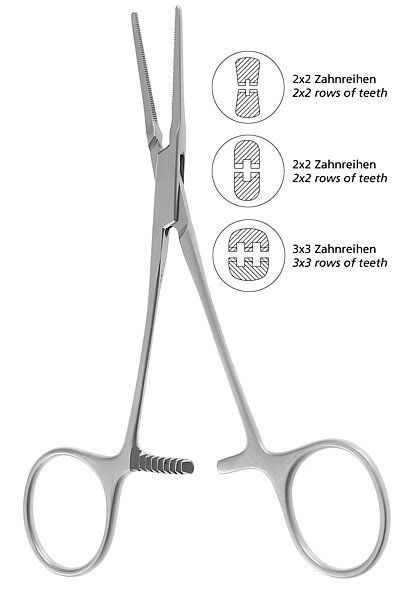
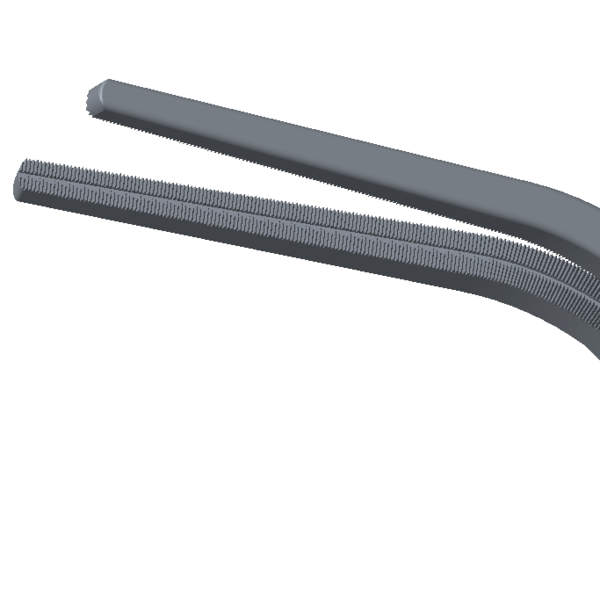
The typical feature of the atraumatic surgical instruments is the design of the jaw. The unique serration and arrangement of the teeth makes the jaw of Cooley instruments so special. The single or double serration allows the tissue or organs to be injured as little as possible during surgery. There are different variations of jaw surfaces:
Who invented it?
The surgeon with Heart: Denton A. Cooley - VITA:
- studied medicine at the University of Texas Medical Branch in Galveston and the John Hopkins University School of Medicine
- 1950: finished residency, work in London, collaboration with cardiac surgeon Lord Russell Brock
- 1951: worked in Houston as Associate Professor of Surgery at the Baylor College of Medicine, collaboration with Michael Ellis DeBakey
- 1968: first heart transplant
(text source: Wikipedia)
Instruments Made in Germany - How did the August Reuchlen company come to Cooley?
The cooperation with William Merz, former instrument maker and later Vice President of V. Mueller in Chicago, and August Reuchlen began far before the introduction of the Cooley clamps in the late 1960s. After Merz chose the August Reuchlen company in Tuttlingen for the complex production of the Debakey, Mueller-Markham and Glassman serrations, which are also atraumatic, Reuchlen also became involved in the manufacturing of the Cooley clamps. In order to produce the fine toothing, it was necessary to purchase new machines. At this time, the August Reuchlen company was the only company that produced Cooley for V. Mueller. Interesting side note: Before the surgical devices manufactured so far, known by the V. Mueller catalog, went into circulation, Dr. Cooley himself tested the instruments on his own operating table. This process, in consultation with William Merz and August Reuchlen, resulted in frequent re-adjustment and fine-tuning of the serrations.
You can find our atraumatic instruments such as clamps, forceps, and retractors in our brochures: Kardiovaskular I Neonatal.
Need help? Please contact us:
Tel. +49 (0) 74 61 / 96 52 - 0
info@reuchlen.com



Keyhole Surgery
Minimally invasive cardiac surgery (MICS) refers to operations performed via the chest. The instruments used in ‘keyhole surgery’ typically consist of a tube and a trocar, which is inserted through the chest wall after two or three small incisions. Due to the lack of negative pressure in the chest cavity, the lung collapses, and the resulting space allows the surgeon to view the chest cavity. The patient is ventilated using a double-lumen tube. The advantage of this type of operation is that it avoids the need to open the chest. The small incisions offer a number of benefits for the patient:
- Reduced post-operative pain
- Fewer complications after surgery
- Faster healing and and thereby a considerable shorter stay
- Significantly smaller scarring
Video-assisted thoracic surgery (VATS) instruments represent a further development of the surgical technique described above. These versatile, functional and precision instruments make surgeons’ work easier and offer many advantages:
- The instruments can be completely dismantled. This makes a hygienic cleaning easier
- All components of the instruments can be ordered individually if required, meaning that a complete instrument does not need to be remanufactured.
This type of minimally invasive surgery is used in the following areas:
- Tumour removal
- Thymus removal
- Diaphragmatic disorders
- Anatomical lung lobe resection
- Treatment of pneumothorax
- Treatment of chest trauma
- Removal of lung metastases
- etc.
Examples of our MICS/VATS instruments: surgical clamps, scissors and suction devices for minimally invasive and video-assisted surgery by August Reuchlen can be found in our MICS VATS Brochure.
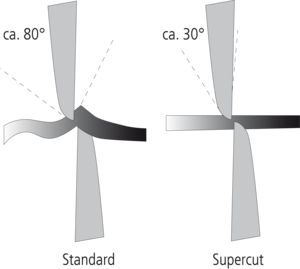
Super-Cut-Schliff Super-Cut finish
The Super-Cut edge refers to a special geometry of the cutting edge on surgical scissors. One cutting edge features fine micro-serrations, while the opposite edge is smooth. This combination ensures a secure gripon the tissue, prevents slipping, and enables a precise, controlled cut. Instruments with a Super Cut edge are characterized by high cutting performance, long service life, and reliable cutting control.